















- Home
- Commentaries and Reports
- Interviews with Edward L. "Ned" Davis - Fourth in a Series
Interviews with Edward L. "Ned" Davis - Fourth in a Series
- By Delia Stafford-Johnson Columnist EdNews.org
- Published 04/3/2007
- Commentaries and Reports
-
Rating:


Delia Stafford-Johnson Columnist EdNews.org
Ms. Stafford-Johnson is the President & CEO of The Haberman Educational Foundation, Inc. In Houston (TX). For nearly a decade, Ms. Stafford-Johnson directed the nation's largest school district-based alternative teacher certification program in Houston Independent School District. She was twice recognized at White House ceremonies for her success in that program and her advocacy in finding good teachers for children at risk and in poverty. In addition to research interests in alternative teacher certification and teacher selection, Ms. Stafford-Johnson's publications include urban school district-based teacher education, violence prevention, beliefs of effective teachers, student resilience, and research implementation. Ms. Stafford began The Haberman Educational Foundation in 1994 for the purpose of making visible and lasting improvements in the education of America's 15 million diverse children in poverty.
View all articles by Delia Stafford-Johnson Columnist EdNews.orgInterview with Edward L. "Ned" Davis - Fourth in a Series
President &CEO
Haberman Educational Foundation
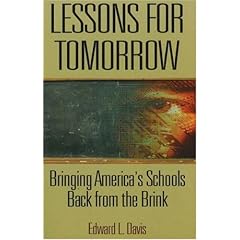
This is the fourth in a series of interviews with Edward L. "Ned" Davis, author of the acclaimed book on redesigning America's public education system, "Lessons For Tomorrow, Bringing America's Schools Back From The Brink." Davis was a recipient of the EdNews Upton Sinclair Awards, 2006 for being one of the ten most outstanding contributors and thought leaders in education. Many 'futurists' paint interesting, even inspiring pictures of where we are going in education. Davis does all of that, but most importantly, his vision is grounded in several major disciplines that are crucial to understanding the evolution of learning.
In our first interview we discussed how radical centralization was a necessary element in enabling radical decentralization in the redesign of our public education system. In the second interview, we discussed technology, with particular focus on the future of 'learning management systems' designed from a learner-centric perspective. In the last interview, I spoke to Davis about how the roles of teachers and students would change in a 21st century design for public schooling.
DS-Welcome back! I thought we would have a more free-wheeling discussion this time. I have several questions I would like to ask-starting with this. You have had a long career in education and technology. I believe you told me you were in on the beginning of distance learning. Tell me what you have seen change since the beginning. Have we actually evolved in our approach to using technology for learning.
ND-To answer your last question first, not much! The technology itself has involved tremendously. When I started with PLATO in the early seventies, it was dumb terminals hooked up to mainframe computers. When I launched the first commercially successful pc-to-pc learning network (The Electronic University Network), there was no World Wide Web. There wasn't even dial-up internet service as we now know it. Much has changed allowing us to convey text and images to one another, chat live online, etc.
The social aspects of the Web have changed how we communicate. Sites like My Space and You Tube are transforming social networking and even reinvigorating democracy. But the bottom line is, we have not tapped into these new kinds of technologies and social networking to enable learning.
DS-Why do you think that is?
ND-I think its just lack of imagination. Many are still fooling around with live instruction online, when all of the research and experience we have shows that the advantages of transcending time and place greatly outweigh any imagined or real advantages to live instruction.
Most states still require that a teacher deliver a course that is online. This is crazy if you fully understand what can be done with technology. A well-designed course can be teacher-less. It can be mentored by a graduate student at a fraction of the cost, as some are now doing, or it can be facilitated by a teacher on-site who can use a well-designed course to focus on individualized attention to students rather than delivering classroom lectures to a group of 30. As I have said many times, we must re-conceptualize the role of teachers and take away the labor-intensive drudgery of lesson preparation, testing and record keeping so that they can focus on individual students and creative/spontaneous responses to what is happening in the classroom.
DS-What is it going to take to match the technological capabilities we have with human skills?
ND-I think that is a great question Delia, because it goes to the area where we have failed in education. Our history, for more than a century, has been to automate the process--to generate as close to uniform outputs as we can. I'm starting to sound like a broken record, but this is crazy. People are not the same. They don't learn at the same pace, or in the same way, they have different interests and aptitudes, and they will increasingly resist attempts to use technology in uniform ways.
Young people see the freedom and individuality associated with technology. They certainly sense that cell phones and laptops and iPods enable and empower their individual initiative. All of this is happening while we, in education, continue to try to homogenize and mass-produce. Standardized testing, the way courses are conducted and classes are managed, the way students are herded from one place to the next after a bell rings every 50 minutes-all of these things work against the grain of cognitive development.
We do a particularly bad job at the social aspects of learning. For
instance, students are given no stake in their own governance. Why should we adults be cast in the role of cops in the classroom when we could involve students in making and enforcing rules of conduct in a learning environment? As I mentioned in our last interview, this has been done with great success at schools like Sudbury, Summerhill, and Montessori for many years. These schools tend to produce highly responsible, socially engaged citizens from all walks of life.
Another social failure-We do a terrible job of exposing young people to what it is really like to be working in a given trade or profession. The moment they exhibit the slightest curiosity, we should be exposing them to videos, communities of interest and practice, internships and apprenticeships that immerse them in the real day-to-day experience of a job, and what it takes to perform. The intellectual and the abstract needs to be placed into a real context in the real world, or we are literally ignoring half of what it means to become educated. Technology greatly leverages our ability to enhance the social aspects of learning and yet we are not using it that way.
DS-Shouldn't we also be giving students a chance to develop real-world skills at an earlier age? It seems we keep them dependent and passive past the time when many of them might be inclined to gain more from learning and applying useful skills-and getting paid for it!
ND-An excellent point. All of the current rhetoric seems to say that a high school education is insufficient in the twentieth century. From there, most people here in the U.S. tend to make the leap that everyone needs to go on to college. Don't get me wrong. I wish everyone could. I wish everyone were so inclined. But, the truth is, many are more inclined to look for decent jobs while still in their teen years, and get out into what is, for them, the real world. We do very little to facilitate this for those who make that choice -another significant social failure. Again, not all of us are inclined to go on to higher education. And I think we stigmatize those who are not by levying a single standard (a college degree) on everyone.
The European Union recognizes something that we here do not. There are many occupations that require a specialized technical training and apprenticeships in order to prepare young people for well-paid and technical job areas like: electronics, computers and information technology, marketing, medical technology, the building trades, agricultural technology, manufacturing and finance. Some of these kinds of jobs are learned by acquiring specific trade and professional certifications, along with putting in some time in the workplace. Many such certifications can be pursued and even completed in high school. The foundation I work for (the National Education Foundation) offers over 60 professional certifications (mostly in the IT area), which can be completed at the high school level. We are committed to install an IT academy in every school district in the U.S. by 2016.
Europeans recognize trades and technical professions as dignified and respectable work. Countries like Germany invest in research to determine how various industries are transitioning to newer technologies and vocational specialties. This research eventually turns into training and school-to-work transition programs in high schools. Many who acquire these technical skills through education programs and apprenticeships can elect to go to work straight out of high school in relatively well-paying jobs. Many such technical workers go on to specialized higher education later to improve their career prospects. Research shows that early vocational and technical training leads to self-esteem among many, especially the disadvantaged; and it also leads to entrepreneurial activity.
Here in the U.S. we have very little in the way of alternate pathways to vocational and technical careers for the 21st century. The opportunities don't exist, and therefore we lag behind other countries that make a point of developing specialized labor pools that feed into technical professions. We talk about needing more people to excel in math and science. We don't talk about diverting young people into technical careers that utilize these disciplines. We should be talking about, and doing, both.
DS--Can these kinds of jobs be taught online, especially in rural and small schools where budgets aren't there to hire specialized teachers?
ND-We are doing that with digital literacy and our professional
certifications in computer-based professions. Some of them are creative, like becoming a web designer, and some of them very technical, like managing a local area network for a corporation or government entity. And I would add that learning these skills online can work very well with the proper kind of curriculum and on-site support. Most big city schools don't have the funds to hire more teachers either.
DS-So why isn't there more online instruction making its way into schools?
ND-Well, there's the obvious. Educators, administrators and unions often don't like the idea. Parents aren't aware of the research that shows the high completion and retention rates with well-run online learning programs (better than traditional classrooms in many instances). And kids haven't been provided with the independent study skills that give them the confidence to sign up for a class online. When we begin to get over those hurdles, and we will, you will see enormous growth. Last year, something like 700,000 K-12 students took an online course, so we are making progress. In 5 years I expect that number to at least quadruple, but even those numbers will be modest compared to where we need to be.
Distributed learning is a real solution to some of the problems and
opportunities we face. The not-so-obvious impediments are better online course design and better distribution methods. Right now, for example, many states are starting virtual high schools and using educators to host, develop, market and support the use of online curriculum. Almost all of these online high schools are required to be self-supporting so they have to add charges to the curriculum they provide to sustain themselves. This is an unworkable model.
DS-What is a workable model?
ND-One workable model is to use school and community libraries as distribution points for curriculum. They have physical facilities (which the online high schools don't) they have research and multimedia capabilities. They usually have computers. They have the capacity to inform everyone in their local communities about courses available as well as the advantages of online instruction. They could host regular sessions that show young people, teachers and adult learners the advantages of an online course. With training, they could help students sign up for courses, and even provide them with information about jobs that are available in given areas where vocational and technical training is provided. We are working on just such a program right now with the Library of Michigan, through their excellent e-library program (www.mel.org).
DS-Back to unions for a minute. It would seem that they might present a real obstacle to actually integrating online learning into the school system, and also to using libraries to help distribute courses.
ND-Maybe so, but all of us, including the unions need to start recognizing that the cost of labor is killing us in education. Most states are prevented from diverting funds to innovation because they can't even keep up with the costs of pensions and healthcare benefits. There is no alternative. Some large school systems have gone bankrupt and more will follow without technological innovation. We have to start using economies of scale to designhigh quality curriculum. This means keeping our best teachers (and paying them more money) and replacing mediocre and poor performers with better teaching and learning methodologies. It also means empowering capable teachers with tools that make their jobs easier so that we don't drive them out of the system. I think some union organizations are more progressive than others, and are beginning to deal with these
realities.
DS-Do you see innovation going on anywhere? I need some good news.
ND-Certainly there are pockets of brilliance all around us. Innovative charter schools, excellent teachers really getting kids excited about learning in ordinary public schools, highly successful alternative approaches to education, some whom I mentioned previously. It's a good time to be working in education reform, because a lot of educators really do understand much of what needs to happen.
DS-What about innovators in the use of technology?
ND-Google HighTechHigh.org and you will learn about a number of schools in California that are doing very innovative things with technology. Go to the Gates Foundation site and read about what they are doing to develop high tech high schools around the country-also very interesting. I just visited with a company in Dallas that has a revolutionary approach to K-12 teaching using laptops and a very well thought out approach to learning design.
Lectures are provided by expert and entertaining college professors. The assessment and testing process is highly automated and simplified tremendously for teachers. Parents can check at any time through the system to see how their children are doing. The lessons themselves use multi-media skillfully and are designed to accommodate multiple learning styles. This is an exciting new platform that you will be hearing about soon. All of these developments give me hope that we can change.
DS-So classroom teachers are a part of the system developed in Dallas?
ND-Sure. It is much more desirable, from my point of view to have a live teacher facilitating on site with an online course, than trying to "teach" at a distance. This will be one of the workable models in future if we can figure out how to get costs down. 90% of the cost in education is labor. We have no choice but to reduce that cost as we move into the future. As you know, I peak to this issue in depth in my book.
DS-It sure would be nice if there was a higher degree of collaboration in the system overall, so that the less evolved people and institutions could learn from those who are on the cutting age.
ND- Collaboration, is the word I believe, that will that will drive the master skill of the 21st century. All of us need to get better at it. So much of what's wrong with education is directly attributable to a lack of collaboration between schools, districts and states. An ex-superintendent of instruction here in Michigan pointed out to me that a single district could have saved about $10 million annually just by consolidating bus routes. That's with no loss of service! Certainly there are tens of thousands of similar issues throughout the system. We need to make organization and expenditures transparent in education, and Lord knows, we need to learn how to collaborate in order to innovate. Education should be modeling collaboration for the rest of us in government and the private sector. Instead, it is a case study in how not to evolve, not to design work processes, or increase efficiency and effectiveness.
DS-This seems like a good note to end on, Ned. Let's all take a course in collaboration!
ND-I couldn't agree with you more Delia. Where do I sign up?
Edward "Ned" Davis is currently Vice President of Education Policy for the National Education Foundation in Alexandria, VA. He lives in Michigan and invites comment on this series of articles. Ned can be reached by email at [email protected].
üThis is the third in a series of interviews with Edward L. "Ned" Davis
üBuilding Smart Environments—The Future of Learning Management Systems
üRadical Decentralization and Radical Centralization in Education - Part 1
order now
Published March 4, 2007
Spread The Word
Related Articles
Comments

